Consider the Proth space

Using the above conjecture we have established the following
By tabulating order of groups next we provide examples where order follows the conjecture and other examples where the Proth number used is composite.
We will be using generating element 2
When t=3 we have P=1+9×64 and the set of elements modulo P is a multiplicative group.
The subgroup generated by 2 has 144 elements
Order is (2^4)×(1+2^3) so we are a [probable] prime.
The elements in TPc144 are as shown next
{ 2, 4, 8, 16, 32, 64, 128, 256, 512, 447,
317, 57, 114, 228, 456, 335, 93, 186, 372, 167,
334, 91, 182, 364, 151, 302, 27, 54, 108, 216,
432, 287, 574, 571, 565, 553, 529, 481, 385, 193,
386, 195, 390, 203, 406, 235, 470, 363, 149, 298,
19, 38, 76, 152, 304, 31, 62, 124, 248, 496,
415, 253, 506, 435, 293, 9, 18, 36, 72, 144,
288, -1, 575, 573, 569, 561, 545, 513, 449, 321,
65, 130, 260, 520, 463, 349, 121, 242, 484, 391,
205, 410, 243, 486, 395, 213, 426, 275, 550, 523,
469, 361, 145, 290, 3, 6, 12, 24, 48, 96,
192, 384, 191, 382, 187, 374, 171, 342, 107, 214,
428, 279, 558, 539, 501, 425, 273, 546, 515, 453,
329, 81, 162, 324, 71, 142, 284, 568, 559, 541,
505, 433, 289, 1 }
Next we look at 2177=7*311 and see order is 465 so does not follow the rule established in the conjecture as the Proth number is composite.
For 2177 from t=4 the 465 elements in TPc465 are not tabulated here
For 8449 from t=5 the 840 elements in TPc840 are not tabulated here
For 33281 from t=6 the 7953 elements in TPc7953 are not tabulated here
For 132097 from t=7 the 6972 elements in TPc6972 are not tabulated here
For 526337 from t=8 the 17688 elements in TPc17688 are not tabulated here
For 2101249 from t=9 the 525312 elements in TPc525312 are not tabulated here
For 8396801 from t=10 the 298680 elements in TPc298680 are not tabulated here
A script based on the conjecture is shown next
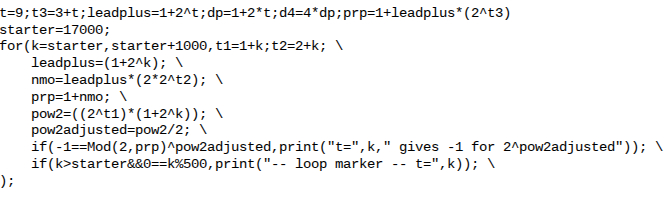
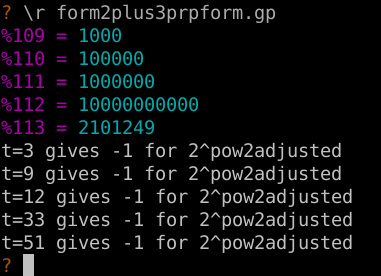
Running that script for t to 500 gives some small examples that fit with the conjecture
A question that applies to all such searches once t becomes large is whether the primes exist.
This is an open question not answered here.
Do adjust the value for starter to search from the starting t value you require and run the script in Pari/GP or adapt it for your favoured computer algebra package.