Consider the Proth space

Using the above conjecture we have established the following
By tabulating order of groups next we provide examples where order follows the conjecture and other examples where the Proth number used is composite.
We will be using generating element 2
When t=1 we have P=1+1×16 and the set of elements modulo P is a multiplicative group.
The subgroup generated by 2 has 8 elements
Using prefix TNz to avoid clashing with existing letter conventions for groups.
Prefer G or S? Replace them in your local copy.
The elements in TNz8 are { 2, 4, 8, -1, 15, 13, 9, 1 }
If TNz8 is really a group then we need inverses so let us document those next.
- Inverse of 2 is 9 mod P
- Inverse of 4 is 13 mod P
- Inverse of 8 is 15 mod P
Later we look at 1921=17*113 and see order is 56 so does not follow the rule established in the conjecture as the Proth number is composite.
For 97 from t=2 the 48 elements in TNz48 are as shown next.
{ 2, 4, 8, 16, 32, 64, 31, 62, 27, 54,
11, 22, 44, 88, 79, 61, 25, 50, 3, 6,
12, 24, 48, -1, 95, 93, 89, 81, 65, 33,
66, 35, 70, 43, 86, 75, 53, 9, 18, 36,
72, 47, 94, 91, 85, 73, 49, 1 }
For 449 from t=3 the 224 elements in TNz224 are as shown next.
{ 2, 4, 8, 16, 32, 64, 128, 256, 63, 126,
252, 55, 110, 220, 440, 431, 413, 377, 305, 161,
322, 195, 390, 331, 213, 426, 403, 357, 265, 81,
162, 324, 199, 398, 347, 245, 41, 82, 164, 328,
207, 414, 379, 309, 169, 338, 227, 5, 10, 20,
40, 80, 160, 320, 191, 382, 315, 181, 362, 275,
101, 202, 404, 359, 269, 89, 178, 356, 263, 77,
154, 308, 167, 334, 219, 438, 427, 405, 361, 273,
97, 194, 388, 327, 205, 410, 371, 293, 137, 274,
99, 198, 396, 343, 237, 25, 50, 100, 200, 400,
351, 253, 57, 114, 228, 7, 14, 28, 56, 112,
224, -1, 447, 445, 441, 433, 417, 385, 321, 193,
386, 323, 197, 394, 339, 229, 9, 18, 36, 72,
144, 288, 127, 254, 59, 118, 236, 23, 46, 92,
184, 368, 287, 125, 250, 51, 102, 204, 408, 367,
285, 121, 242, 35, 70, 140, 280, 111, 222, 444,
439, 429, 409, 369, 289, 129, 258, 67, 134, 268,
87, 174, 348, 247, 45, 90, 180, 360, 271, 93,
186, 372, 295, 141, 282, 115, 230, 11, 22, 44,
88, 176, 352, 255, 61, 122, 244, 39, 78, 156,
312, 175, 350, 251, 53, 106, 212, 424, 399, 349,
249, 49, 98, 196, 392, 335, 221, 442, 435, 421,
393, 337, 225, 1 }
For 1921 from t=4 the 56 elements in TNz56 are as shown next.
{ 2, 4, 8, 16, 32, 64, 128, 256, 512, 1024,
127, 254, 508, 1016, 111, 222, 444, 888, 1776, 1631,
1341, 761, 1522, 1123, 325, 650, 1300, 679, 1358, 795,
1590, 1259, 597, 1194, 467, 934, 1868, 1815, 1709, 1497,
1073, 225, 450, 900, 1800, 1679, 1437, 953, 1906, 1891,
1861, 1801, 1681, 1441, 961, 1 }
For 7937 from t=5 the 3968 elements in TNz3968 are not tabulated here
For 32257 from t=6 the 16128 elements in TNz16128 are not tabulated here
For 130049 from t=7 the 10603 elements in TNz10603 are not tabulated here
For 522241 from t=8 the 14457 elements in TNz14457 are not tabulated here
For 2093057 from t=9 the 20520 elements in TNz20520 are not tabulated here
For 8380417 from t=10 the 4190208 elements in TNz4190208 are not tabulated here
For 33538049 from t=11 the 16769024 elements in TNz16769024 are not tabulated here
For 134184961 from t=12 the 246480 elements in TNz246480 are not tabulated here
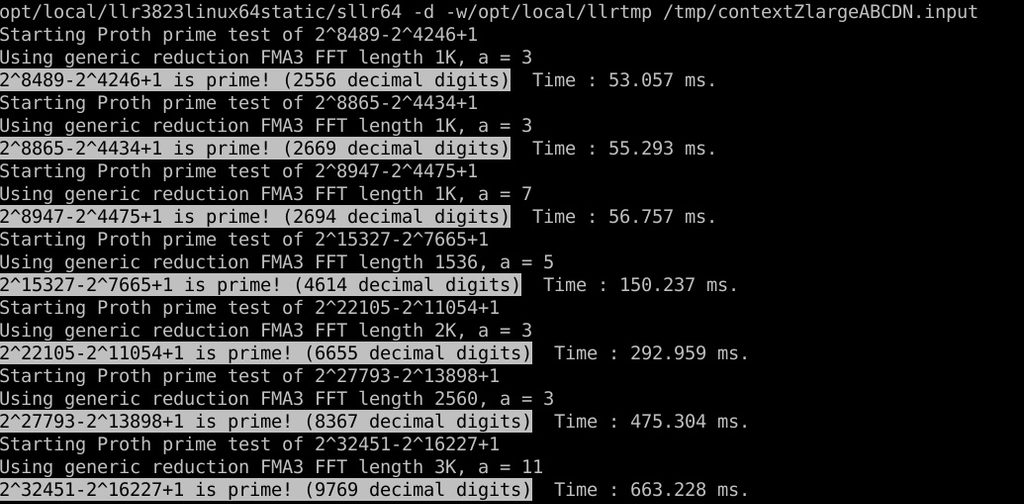
Prime testing of some of the larger examples found using the conjecture is shown next
Further work on this set of numbers has produced the following improved conjecture
