Category: abstractalgebra

  • Element 5 and set 1+(1+5^t)*(5^t)

    Consider the space

    1+(1+5t)∗(5t)1+(1+5^t)*(5^{t})

    We will be using generating element 5

    The groups generated by 5 have low order [ a lot lower than n-1 ]

    Tabulating the elements of groups generated by 5 next

    Using prefix NPh to avoid clashing with existing letter conventions for groups.
    Prefer G or S? Replace them in your local copy.

    Conjecture: Order of 5 mod N when N of the form 1+(1+5^t)*(5^t) is 3×t

    When t=1 we have P=1+6×5 and the set of elements modulo P is a multiplicative group.


    The subgroup generated by 5 has 3 elements


    The elements in NPh3 are { 5, 25, 1 }

    If NPh3 is really a group then we need inverses so let us document those next.

    • Inverse of 5 is 25 mod P

    For 651 from t=2 the 6 elements in NPh6 are as shown next
    { 5, 25, 125, 625, 521, 1 }


    For 15751 from t=3 the 9 elements in NPh9 are as shown next
    { 5, 25, 125, 625, 3125, 15625, 15121, 12601, 1 }


    For 391251 from t=4 the 12 elements in NPh12 are as shown next
    { 5, 25, 125, 625, 3125, 15625,
    78125, 390625, 388121, 375601, 313001, 1 }

    For 9768751 from t=5 the 15 elements in NPh15 are as shown next
    { 5, 25, 125, 625, 3125, 15625,
    78125, 390625, 1953125, 9765625, 9753121, 9690601,
    9378001, 7815001, 1 }


    For 244156251 from t=6 the 18 elements in NPh18 are as shown next
    { 5, 25, 125, 625, 3125, 15625,
    78125, 390625, 1953125, 9765625, 48828125, 244140625,
    244078121, 243765601, 242203001, 234390001, 195325001, 1 }

    For 6103593751 from t=7 the 21 elements in NPh21 are as shown next
    { 5, 25, 125, 625, 3125, 15625,
    78125, 390625, 1953125, 9765625, 48828125, 244140625,
    1220703125, 6103515625, 6103203121,
    6101640601, 6093828001, 6054765001,
    5859450001, 4882875001, 1 }

    For 152588281251 from t=8 the 24 elements in NPh24 are as shown next
    { 5, 25, 125, 625, 3125,
    15625, 78125, 390625, 1953125, 9765625,
    48828125, 244140625, 1220703125, 6103515625, 30517578125,
    152587890625, 152586328121, 152578515601,
    152539453001, 152344140001, 151367575001,
    146484750001, 122070625001, 1 }

    For t=9 the 27 elements in NPh27 are not tabulated here
    For t=10 the 30 elements in NPh30 are not tabulated here
    For t=11 the 33 elements in NPh33 are not tabulated here
    For t=12 the 36 elements in NPh36 are not tabulated here
    For t=13 the 39 elements in NPh39 are not tabulated here
    For t=14 the 42 elements in NPh42 are not tabulated here
    For t=15 the 45 elements in NPh45 are not tabulated here
    For t=16 the 48 elements in NPh48 are not tabulated here
    For t=17 the 51 elements in NPh51 are not tabulated here
    For t=18 the 54 elements in NPh54 are not tabulated here
    For t=19 the 57 elements in NPh57 are not tabulated here
    For t=20 the 60 elements in NPh60 are not tabulated here

    Using sturdy element notation we might say the results tabulated in this post are

    sturdy element notation for element 5 in enclosing set 1+(1+5^t)*(5^t)
  • Element 5 and set 1+(-1+5^t)*(5^t)

    Consider the space

    1+(−1+5t)∗(5t)1+(-1+5^t)*(5^{t})

    We will be using generating element 5

    The groups generated by 5 have low order [ a lot lower than n-1 ]

    Tabulating the elements of groups generated by 5 next

    Using prefix NNd to avoid clashing with existing letter conventions for groups.
    Prefer G or S? Replace them in your local copy.

    Conjecture: Order of 5 mod N when N of the form 1+(-1+5^t)*(5^t) is 6×t

    When t=2 we have P=1+24×25 and the set of elements modulo P is a multiplicative group.


    The multiplicative group generated by 5 has 12 elements


    The elements in NNd12 are
    { 5, 25, 125, 24, 120, -1, 596, 576, 476, 577, 481, 1 }

    If NNd12 is really a group then we need inverses so let us document those next.

    • Inverse of 5 is 481 mod P
    • Inverse of 25 is 577 mod P
    • Inverse of 125 is 476 mod P
    • Inverse of 24 is 576 mod P
    • Inverse of 120 is 596 mod P

    We could alternatively write the group NNd12 as follows:
    { 5, 25, 125, (5^4), (5^5), -1,
    -5, -25, -125, -(5^4), -(5^5), 1, }

    For 15501 from t=3 the 18 elements in NNd18 are as shown next
    { 5, 25, 125, 625, 3125, 124, 620, 3100, -1,
    15496, 15476, 15376, 14876, 12376, 15377, 14881, 12401, 1 }

    For 390001 from t=4 the 24 elements in NNd24 are as shown next
    { 5, 25, 125, 625, 3125, 15625, 78125, 624,
    3120, 15600, 78000, -1, 389996, 389976, 389876, 389376,
    386876, 374376, 311876, 389377, 386881, 374401, 312001, 1 }

    For 9762501 from t=5 the 30 elements in NNd30 are as shown next
    { 5, 25, 125, 625, 3125, 15625,
    78125, 390625, 1953125, 3124, 15620, 78100,
    390500, 1952500, -1, 9762496, 9762476, 9762376,
    9761876, 9759376, 9746876, 9684376, 9371876, 7809376,
    9759377, 9746881, 9684401, 9372001, 7810001, 1 }

    For 244125001 from t=6 the 36 elements in NNd36 are as shown next
    { 5, 25, 125, 625, 3125, 15625,
    78125, 390625, 1953125, 9765625, 48828125, 15624,
    78120, 390600, 1953000, 9765000, 48825000, -1,
    244124996, 244124976, 244124876,
    244124376, 244121876, 244109376,
    244046876, 243734376, 242171876,
    234359376, 195296876, 244109377,
    244046881, 243734401, 242172001,
    234360001, 195300001, 1 }

    For 6103437501 from t=7 the 42 elements in NNd42 are as shown next
    { 5, 25, 125, 625, 3125, 15625,
    78125, 390625, 1953125, 9765625, 48828125, 244140625,
    1220703125, 78124, 390620, 1953100, 9765500, 48827500,
    244137500, 1220687500, -1,
    6103437496, 6103437476, 6103437376,
    6103436876, 6103434376, 6103421876,
    6103359376, 6103046876, 6101484376,
    6093671876, 6054609376, 5859296876,
    4882734376, 6103359377, 6103046881,
    6101484401, 6093672001, 6054610001,
    5859300001, 4882750001, 1 }

    For t=8 the 48 elements in NNd48 are not tabulated here
    For t=9 the 54 elements in NNd54 are not tabulated here
    For t=10 the 60 elements in NNd60 are not tabulated here
    For t=11 the 66 elements in NNd66 are not tabulated here
    For t=12 the 72 elements in NNd72 are not tabulated here
    For t=13 the 78 elements in NNd78 are not tabulated here
    For t=14 the 84 elements in NNd84 are not tabulated here
    For t=15 the 90 elements in NNd90 are not tabulated here
    For t=16 the 96 elements in NNd96 are not tabulated here
    For t=17 the 102 elements in NNd102 are not tabulated here
    For t=18 the 108 elements in NNd108 are not tabulated here
    For t=19 the 114 elements in NNd114 are not tabulated here
    For t=20 the 120 elements in NNd120 are not tabulated here

    Using sturdy element notation we might say the results tabulated in this post are

    sturdy element notation for element 5 in enclosing set 1+(-1+5^t)*(5^t)
  • Masters project or PhD subject?

    If you are a Masters student and interested in doing a project or PhD in Abstract Algebra, then read on.

    Cyclic groups are an area of active research.

    There are three themes for projects based on content on this site

    • Isomorphisms between cyclic groups
    • Observations / conjectures about order
    • Definitions of [sub]group and where the groups documented on this site should fit?

    Those themes should offer extensive opportunities for studying cyclic groups inspired by work in this blog and comparisons to known cyclic subgroups documented in other research.

    Questions that might be answered in your research might include any of the following:

    • How many non-isomorphic groups are there with 36 elements?
    • How many non-isomorphic groups are there with 42 elements?
    • How many non-isomorphic groups are there with 52 elements?
    • How many non-isomorphic groups are there with 68 elements?
    • How do we classify a cyclic group that has a parent set but no parent group?
    • What do we call an element that takes a loose structure like a set and always produces a stronger mathematical structure [ a group ]?
    • What do the lattices look like for the groups X and Y on this site
    • Does Burnside pq theorem apply to all groups with even order?
    • Should we use double angle brackets or is existing notation sufficient?

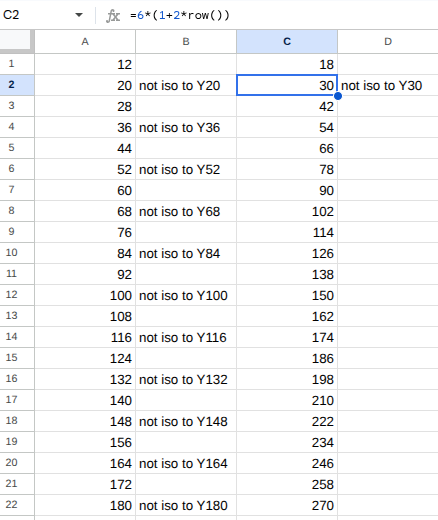
    When thinking about isomorphisms or not you may end up considering X and P and conjectures about their order with a table inspired by the following:

    In that table I say ‘not iso’ but these are open questions which I have provided no answer to.

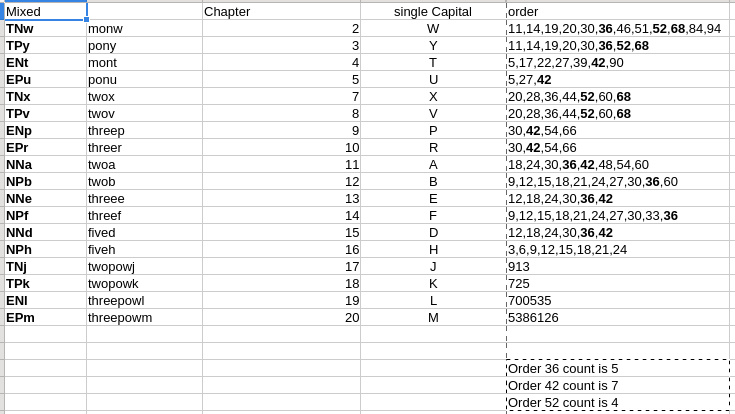
    For questions about order 36, 42, 52, 68 the following group lists may give you cyclic [abelian] group examples to use as examples when talking about where multiplicative groups having that order occur.

    Lookup table with highlighted entries for order 36,42,52,68

    If you are still short of project material, then you can always prove some conjectures

  • What’s in a name “The monty and pony papers”

    Finding new Mathematical structures is not just fun, that knowledge needs to be shared.

    Something that has not been straightforward is the naming of groups.

    At least two of these groups have new structures that are not isomorphic to any existing cyclic group.

    They will eventually obtain a generally agreed name, however in the meantime the question of naming needed an answer

    Started out using just capital letter and then found that I had used up A, B, E, F, J, K, L, M, P, R, T, U, V, W, X, Y

    Some of those letters may already be used by convention for other things. What to do?

    First attempt at a unique naming scheme that was not single letters resulted in long names.

    Second attempt resulted in group names prefixed by 3 letters.

    In your own papers you are free to use whatever of those naming schemes are a best fit or perhaps just G and S or something in keeping with your other Abstract Algebra papers.

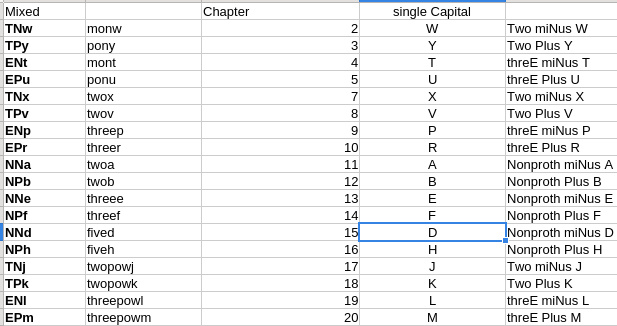
    In a table, those names look like the following:

    Naming by chapter

    One of the things I tried to consider is the group name as part of an individual paper, or a group name as part of a wider context.

    Both have advantages.

    “The monty and pony papers” is just a light hearted concatenation of interim names for what was T and Y

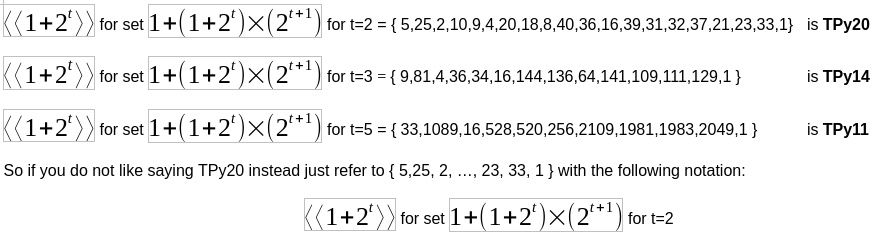
    For an alternative to using [unique] names to groups you could use sturdy element notation as the following example illustrates.

    For referencing any of the group entries in Y you simply need to add a t=number suffix to the notation below:

    Super element notation for ⟨⟨1+2^t⟩⟩ for set 1+(1+2^t)*(2^(t+1))
    Super element notation for ⟨⟨1+2^t⟩⟩