If you are a Masters student and interested in doing a project or PhD in Abstract Algebra, then read on.
Cyclic groups are an area of active research.
There are three themes for projects based on content on this site
- Isomorphisms between cyclic groups
- Observations / conjectures about order
- Definitions of [sub]group and where the groups documented on this site should fit?
Those themes should offer extensive opportunities for studying cyclic groups inspired by work in this blog and comparisons to known cyclic subgroups documented in other research.
Questions that might be answered in your research might include any of the following:
- How many non-isomorphic groups are there with 36 elements?
- How many non-isomorphic groups are there with 42 elements?
- How many non-isomorphic groups are there with 52 elements?
- How many non-isomorphic groups are there with 68 elements?
- How do we classify a cyclic group that has a parent set but no parent group?
- What do we call an element that takes a loose structure like a set and always produces a stronger mathematical structure [ a group ]?
- What do the lattices look like for the groups X and Y on this site
- Does Burnside pq theorem apply to all groups with even order?
- Should we use double angle brackets or is existing notation sufficient?
When thinking about isomorphisms or not you may end up considering X and P and conjectures about their order with a table inspired by the following:
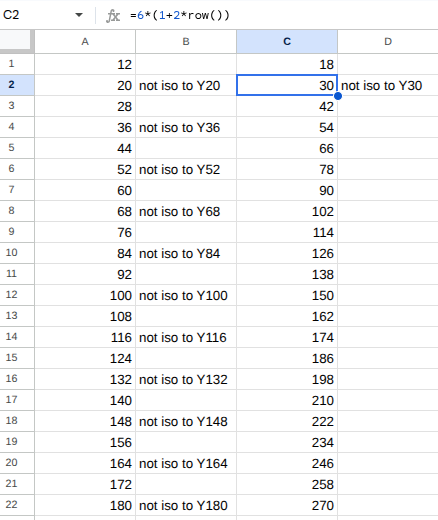
In that table I say ‘not iso’ but these are open questions which I have provided no answer to.
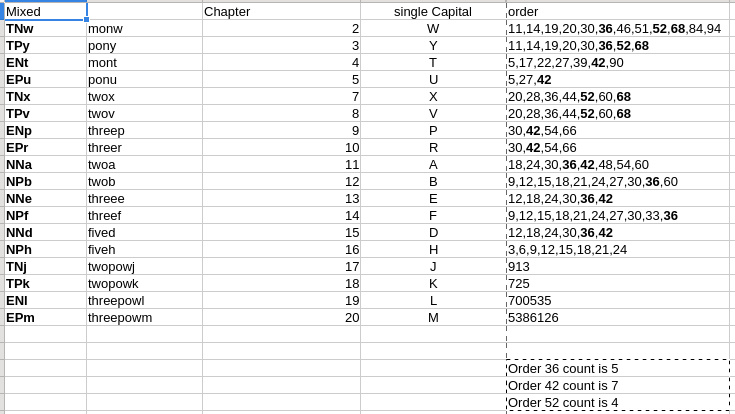
For questions about order 36, 42, 52, 68 the following group lists may give you cyclic [abelian] group examples to use as examples when talking about where multiplicative groups having that order occur.
If you are still short of project material, then you can always prove some conjectures