Blog

  • Sure it’s structure preserving

    An isomorphism is said to be structure preserving


    In fact relationships between elements are maintained even if the elements are renamed or reordered


    But what if a finite multiplicative cyclic group has a secondary feature?

    Allowing both relabelling and reordering means this secondary feature is no longer accessible or usable.

    Does this prevent the mapping being structure preserving?

    A truly structure preserving mapping would allow the use of the secondary feature even after reordering and relabelling.

    Best illustrated with examples.

    Using a generating element of 65 and working modulo 8321 we obtain the 52 element multiplicative group shown next.
    { 65,4225,32,2080,2064,1024,8313,7801,7805,8065,
    2,130,129,64,4160,4128,2048,8305,7281,7289,
    7809,4,260,258,128,8320,8256,4096,8289,6241,
    6257,7297,8,520,516,256,8319,8191,8192,8257,
    4161,4193,6273,16,1040,1032,512,8317,8061,8063,
    8193,1 }

    There is a secondary feature in that group that allows us to jump to a portion of our group and be at most 7 elements from the element we require.


    Every eighth element after 16 from the end of the group is a power of 2.

    In order we would write them as follows

    24,28,212,216,220,224,228,232,236,2402^4, 2^8, 2^{12}, 2^{16}, 2^{20}, 2^{24}, 2^{28}, 2^{32}, 2^{36}, 2^{40}

    Writing them longhand we might say
    eight from last is 16
    sixteenth from last is 2^8
    twentyfourth from last is 2^12
    thirtysecond from last is 2^16
    fortieth from last is 2^20
    fortyeighth from last is 2^24

    The fourth item is in bold in the group listing above and represents 2^24 mod 8321

    Using sturdy element notation we might say the group we tabulated above beginning 65 is

    Sturdy element notation for 1+2^t for set 1+(1+2^t)*(2^(t+1)) for t=6

    Current theory tells us that there exists an isomorphism between this finite abelian cyclic group and the additive group Z52.


    Such an isomorphism would use both relabelling and reordering.

    The problem then becomes how to access the secondary feature?
    We are now [after isomorphism] the group Z52 whose elements are:
    { 1,2,3,4,5,6,7,8,9,10,11,12,13,
    14,15,16,17,18,19,20,21,22,23,24,25,26,
    27,28,29,30,31,32,33,34,35,36,37,38,39,
    40,41,42,43,44,45,46,47,48,49,50,51,52 }

    By allowing reordering without being specific about tracking each element and how it maps individually, we have no way of locating an element of the secondary feature once in Z52


    This prevents us from jumping to a section of the group and navigating a maximum of seven elements from that jump destination.

    That secondary feature is part of our original multiplicative cyclic group.

    We are unable to use that secondary feature.


    Therefore we are not truly structure preserving.

    Next a further example.

    Using a generating element of 257 and working modulo 131585 we obtain the 68 element multiplicative group shown next.
    { 257, 66049, 128, 32896, 32832, 16384, 131553, 123361,
    123377, 127489, 8, 2056, 2052, 1024, 131583, 131071,
    131072, 131329, 65793, 65921, 98817, 64, 16448, 16416,
    8192, 131569, 127473, 127481, 129537, 4, 1028, 1026,
    512, -1, 131328, 65536, 131457, 98689, 98753, 115201,
    32, 8224, 8208, 4096, 131577, 129529, 129533, 130561,
    2, 514, 513, 256, 65792, 65664, 32768, 131521,
    115137, 115169, 123393, 16, 4112, 4104, 2048, 131581,
    130557, 130559, 131073, 1 }

    Using sturdy element notation we might say the group we tabulated above beginning 257 is

    Sturdy element notation for 1+2^t for set 1+(1+2^t)*(2^(t+1)) for t=8

    Labelling that 68 element multiplicative cyclic group as TPy68.


    With a jump or secondary feature similar to our previous example

    eight from last is 16
    sixteenth from last is 2^8
    twentyfourth from last is 2^12
    thirtysecond from last is 2^16
    fortieth from last is 2^20
    fortyeighth from last is 2^24
    fiftysixth from last is 2^28
    sixtyfourth from last is 2^32

    The fourth item is in bold in the group listing above and represents 2^32 mod 131585.


    Current theory tells us that there exists an isomorphism between this finite abelian cyclic group and the additive group Z68.

    Such an isomorphism would use both relabelling and reordering.

    The problem then becomes how to access the secondary feature?

    We are now [after isomorphism] the group Z68 whose elements are
    { 1,2,3,4,5,6,7,8,9,10,11,12,13,14,15,16,17,
    18,19,20,21,22,23,24,25,26,27,28,29,30,31,32,33,34,
    35,36,37,38,39,40,41,42,43,44,45,46,47,48,49,50,51,
    52,53,54,55,56,57,58,59,60,61,62,63,64,65,66,67,68 }

    By allowing reordering without being specific about tracking each element and how it maps individually, we have no way of locating an element of the secondary feature once in Z68


    This prevents us from jumping to a section of the group and navigating a maximum of seven elements from that jump destination.

    That secondary feature is part of our original multiplicative cyclic group TPy68.

    We are unable to use that secondary feature.

    Therefore we are not truly structure preserving.

    If the jump feature is an essential part of the multiplication operation, then you cannot have a structure preserving map.


    Do we make a special case for this type of group, or do we modify or qualify current theory?


    A question that might be hard to answer is do we in fact have the jump feature in the Z group and just need to add something to the labelling to allow it to operate [again]?


    Want to try and highlight in bold the elements in the Z group?
    Would that be enough?

  • Conjectures 1

    Assorted conjectures 1

    Conjecture: Factors of N when t is prime and N of the form 1+(-1+2^t)*(2^(t+1)) and 1+2*t is prime must be either 5 or of the form 1+4*k*(1+2*t) where k is a positive integer

    Example for t=11 pr=8384513 we have the factors 277 and 30269 where 1+2*t is 23

    277=1+4*3 *23

    30269=1+4*7*47*23

    8384513==277*30269

    Conjecture: Order of b mod N when N of the form

    1+(−1+bt)×bt1+(−1+b^t) ×b^t

    is 6×t where b and t are positive integers >=2

    Conjecture: Order of b mod N when N of the form

    1+(1+bt)×bt1+(1+b^t) ×b^t

    is 3×t where b and t are positive integers >=2

    Conjecture: There are an infinite number of cyclic groups having finite order.

    Posts on this site provide an abundant source of cyclic groups.

    1+(−1+216224)×(216227)  is  Prime1+(-1+2^{16224})×(2^{16227}) ~ ~ is ~ ~ Prime

    1+(1+2639)×(2642)  is  Prime1+(1+2^{639})×(2^{642}) ~ ~ is ~ ~ Prime
  • Element 3 and set 1+(1+3^t)×3^t

    Consider the space

    1+(1+3t)∗(3t)1+(1+3^t)*(3^{t})

    We will be using generating element 3

    The groups generated by 3 have low order [ a lot lower than n-1 ]

    Tabulating the elements of groups generated by 3 next

    Using prefix NPf to avoid clashing with existing letter conventions for groups.
    Prefer G or S? Replace them in your local copy.

    Conjecture: Order of 3 mod N when N of the form 1+(1+3^t)*(3^t) is 3×t


    When t=3 we have P=1+28×27 and the set of elements modulo P is a multiplicative group.


    The subgroup generated by 3 has 9 elements


    The elements in NPf9 are as shown next
    { 3, 9, 27, 81, 243, 729, 673, 505, 1 }


    If NPf9 is really a group then we need inverses so let us document those next.

    • Inverse of 3 is 505 mod P
    • Inverse of 9 is 673 mod P
    • Inverse of 27 is 729 mod P
    • Inverse of 81 is 243 mod P

    For 6643 from t=4 the 12 elements in NPf12 are as shown next
    { 3, 9, 27, 81, 243, 729,
    2187, 6561, 6397, 5905, 4429, 1 }


    For 59293 from t=5 the 15 elements in NPf15 are as shown next
    { 3, 9, 27, 81, 243,
    729, 2187, 6561, 19683, 59049,
    58561, 57097, 52705, 39529, 1 }


    For 532171 from t=6 the 18 elements in NPf18 are as shown next
    { 3, 9, 27, 81, 243, 729,
    2187, 6561, 19683, 59049, 177147, 531441,
    529981, 525601, 512461, 473041, 354781, 1 }

    For 4785157 from t=7 the 21 elements in NPf21 are as shown next
    { 3, 9, 27, 81, 243, 729, 2187,
    6561, 19683, 59049, 177147, 531441, 1594323, 4782969,
    4778593, 4765465, 4726081, 4607929, 4253473, 3190105, 1 }


    For 43053283 from t=8 the 24 elements in NPf24 are as shown next
    { 3, 9, 27, 81, 243, 729,
    2187, 6561, 19683, 59049, 177147, 531441,
    1594323, 4782969, 14348907, 43046721, 43033597, 42994225,
    42876109, 42521761, 41458717, 38269585, 28702189, 1 }


    For 387440173 from t=9 the 27 elements in NPf27 are as shown next
    { 3, 9, 27, 81, 243, 729,
    2187, 6561, 19683, 59049, 177147, 531441,
    1594323, 4782969, 14348907, 43046721, 129140163,
    387420489, 387381121, 387263017, 386908705, 385845769,
    382656961, 373090537, 344391265, 258293449, 1 }

    For 3486843451 from t=10 the 30 elements in NPf30 are as shown next
    { 3, 9, 27, 81, 243,
    729, 2187, 6561, 19683, 59049,
    177147, 531441, 1594323, 4782969, 14348907,
    43046721, 129140163, 387420489, 1162261467, 3486784401,
    3486666301, 3486312001, 3485249101, 3482060401, 3472494301,
    3443796001, 3357701101, 3099416401, 2324562301, 1 }

    For 31381236757 from t=11 the 33 elements in NPf33 are as shown next
    { 3, 9, 27, 81, 243,
    729, 2187, 6561, 19683, 59049,
    177147, 531441, 1594323, 4782969, 14348907,
    43046721, 129140163, 387420489, 1162261467, 3486784401,
    10460353203, 31381059609, 31380705313, 31379642425, 31376453761, 31366887769, 31338189793, 31252095865,
    30993814081, 30218968729, 27894432673, 20920824505, 1 }


    For 282430067923 from t=12 the 36 elements in NPf36 are as shown next
    { 3, 9, 27, 81, 243, 729, 2187, 6561, 19683, 59049,
    177147, 531441, 1594323, 4782969, 14348907,
    43046721, 129140163, 387420489, 1162261467, 3486784401,
    10460353203, 31381059609, 94143178827, 282429536481,
    282428473597, 282425284945, 282415718989, 282387021121,
    282300927517, 282042646705, 281267804269, 278943276961,
    271969695037, 251048949265, 188286711949, 1 }

    For t=13 the 39 elements in NPf39 are not tabulated here
    For t=14 the 42 elements in NPf42 are not tabulated here
    For t=15 the 45 elements in NPf45 are not tabulated here
    For t=16 the 48 elements in NPf48 are not tabulated here
    For t=17 the 51 elements in NPf51 are not tabulated here
    For t=18 the 54 elements in NPf54 are not tabulated here
    For t=19 the 57 elements in NPf57 are not tabulated here
    For t=20 the 60 elements in NPf60 are not tabulated here


    Using sturdy element notation we might say the results tabulated in this post are

    Sturdy element notation for 3 for set 1+(1+3^t)*(3^t) for t=3,..,12
  • Element 3 and set 1+(-1+3^t)×3^t

    Consider the space

    1+(−1+3t)∗(3t)1+(-1+3^t)*(3^{t})

    We will be using generating element 3

    The groups generated by 3 have low order [ a lot lower than n-1 ]

    Tabulating the elements of groups generated by 3 next

    Using prefix NNe to avoid clashing with existing letter conventions for groups.
    Prefer G or S? Replace them in your local copy.

    Conjecture: Order of 3 mod N when N of the form 1+(-1+3^t)*(3^t) is 6×t

    When t=2 we have P=1+8×9 and the set of elements modulo P is a multiplicative group.


    The subgroup generated by 3 has 12 elements

    The elements in NNe12 are { 3, 9, 27, 8, 24, -1, 70, 64, 46, 65, 49, 1 }

    If NNe12 is really a group then we need inverses so let us document those next.

    • Inverse of 3 is 49 mod P
    • Inverse of 9 is 65 mod P
    • Inverse of 27 is 46 mod P
    • Inverse of 8 is 64 mod P
    • Inverse of 24 is 70 mod P

    We could alternatively write the group NNe12 as follows:
    { 3, 9, 27, (3^4), (3^5), -1,
    -3, -9, -27, -(3^4), -(3^5), 1, }

    For 703 from t=3 the 18 elements in NNe18 are as shown next
    { 3, 9, 27, 81, 243, 26, 78, 234, -1
    700, 694, 676, 622, 460, 677, 625, 469, 1 }

    For 6481 from t=4 the 24 elements in NNe24 are as shown next
    { 3, 9, 27, 81, 243, 729, 2187, 80, 240, 720,
    2160, -1, 6478, 6472, 6454, 6400, 6238, 5752, 4294, 6401,
    6241, 5761, 4321, 1 }

    For 58807 from t=5 the 30 elements in NNe30 are as shown next
    { 3, 9, 27, 81, 243, 729,
    2187, 6561, 19683, 242, 726, 2178,
    6534, 19602, -1, 58804, 58798, 58780,
    58726, 58564, 58078, 56620, 52246, 39124,
    58565, 58081, 56629, 52273, 39205, 1 }

    For 530713 from t=6 the 36 elements in NNe36 are as shown next
    { 3, 9, 27, 81, 243, 729,
    2187, 6561, 19683, 59049, 177147, 728,
    2184, 6552, 19656, 58968, 176904, -1,
    530710, 530704, 530686, 530632, 530470, 529984,
    528526, 524152, 511030, 471664, 353566, 529985,
    528529, 524161, 511057, 471745, 353809, 1 }

    For 4780783 from t=7 the 42 elements in NNe42 are as shown next
    { 3, 9, 27, 81, 243, 729,
    2187, 6561, 19683, 59049, 177147, 531441,
    1594323, 2186, 6558, 19674, 59022, 177066,
    531198, 1593594, -1, 4780780, 4780774, 4780756,
    4780702, 4780540, 4780054, 4778596, 4774222, 4761100,
    4721734, 4603636, 4249342, 3186460, 4778597, 4774225,
    4761109, 4721761, 4603717, 4249585, 3187189, 1 }

    For t=8 the 48 elements in NNe48 are not tabulated here
    For t=9 the 54 elements in NNe54 are not tabulated here
    For t=10 the 60 elements in NNe60 are not tabulated here
    For t=11 the 66 elements in NNe66 are not tabulated here
    For t=12 the 72 elements in NNe72 are not tabulated here
    For t=13 the 78 elements in NNe78 are not tabulated here
    For t=14 the 84 elements in NNe84 are not tabulated here
    For t=15 the 90 elements in NNe90 are not tabulated here
    For t=16 the 96 elements in NNe96 are not tabulated here
    For t=17 the 102 elements in NNe102 are not tabulated here
    For t=18 the 108 elements in NNe108 are not tabulated here
    For t=19 the 114 elements in NNe114 are not tabulated here
    For t=20 the 120 elements in NNe120 are not tabulated here

    Using sturdy element notation we might say the results tabulated in this post are

    Sturdy element notation for 3 for set 1+(-1+3^t)*(3^t) for t=2,..,7

  • Element 2 and set 1+(1+2^t)*(2^t)

    Consider the space

    1+(1+2t)∗(2t)1+(1+2^t)*(2^{t})

    We will be using generating element 2

    The groups generated by 2 have low order [ a lot lower than n-1 ]

    Tabulating the elements of groups generated by 2 next

    Using prefix NPb to avoid clashing with existing letter conventions for groups.
    Prefer G or S? Replace them in your local copy.

    Conjecture: Order of 2 mod N when N of the form 1+(1+2^t)*(2^t) is 3×t

    When t=3 we have P=1+9×8 and the set of elements modulo P is a multiplicative group.


    The subgroup generated by 2 has 9 elements

    The elements in NPb9 are as shown next
    { 2, 4, 8, 16, 32, 64, 55, 37, 1 }

    If NPb9 is really a group then we need inverses so let us document those next.

    • Inverse of 2 is 37 mod P
    • Inverse of 4 is 55 mod P
    • Inverse of 8 is 64 mod P
    • Inverse of 16 is 32 mod P

    From 273 for t=4 the 12 elements in NPb12 are as shown next
    { 2, 4, 8, 16, 32, 64, 128, 256, 239, 205, 137, 1 }


    From 1057 for t=5 the 15 elements in NPb15 are as shown next
    { 2, 4, 8, 16, 32, 64, 128, 256, 512, 1024,
    991, 925, 793, 529, 1 }

    From 4161 for t=6 the 18 elements in NPb18 are as shown next
    { 2, 4, 8, 16, 32, 64, 128, 256, 512, 1024,
    2048, 4096, 4031, 3901, 3641, 3121, 2081, 1 }

    From 16513 for t=7 the 21 elements in NPb21 are as shown next
    { 2, 4, 8, 16, 32, 64, 128,
    256, 512, 1024, 2048, 4096, 8192, 16384,
    16255, 15997, 15481, 14449, 12385, 8257, 1 }

    From 65793 for t=8 the 24 elements in NPb24 are as shown next
    { 2, 4, 8, 16, 32, 64, 128, 256,
    512, 1024, 2048, 4096, 8192, 16384, 32768, 65536,
    65279, 64765, 63737, 61681, 57569, 49345, 32897, 1 }

    For t=9 the 27 elements in NPb27 are as shown next
    { 2, 4, 8, 16, 32, 64, 128, 256, 512,
    1024, 2048, 4096, 8192, 16384, 32768, 65536, 131072, 262144,
    261631, 260605, 258553, 254449, 264241, 229825, 196993,
    131329, 1 }

    For t=10 the 30 elements in NPb30 are as shown next
    { 2, 4, 8, 16, 32, 64, 128,
    256, 512, 1024, 2048, 4096, 8192,
    16384, 32768, 65536, 131072, 262144,
    524288, 1048576, 1047551, 1045501, 1041401, 1033201,
    1016801, 984001, 918401, 787201, 524801, 1 }

    For t=11 the 33 elements in NPb33 are not tabulated here

    For t=12 the 36 elements in NPb36 are as shown next
    { 2, 4, 8, 16, 32, 64, 128,
    256, 512, 1024, 2048, 4096, 8192,
    16384, 32768, 65536, 131072, 262144,
    524288, 1048576, 2097152, 4194304, 8388608, 16777216,
    16773119, 16764925, 16748537, 16715761, 16650209, 16519105,
    16256897, 15732481, 14683649, 12585985, 8390657, 1 }

    For t=13 the 39 elements in NPb39 are not tabulated here
    For t=14 the 42 elements in NPb42 are not tabulated here
    For t=15 the 45 elements in NPb45 are not tabulated here
    For t=16 the 48 elements in NPb48 are not tabulated here
    For t=17 the 51 elements in NPb51 are not tabulated here
    For t=18 the 54 elements in NPb54 are not tabulated here
    For t=19 the 57 elements in NPb57 are not tabulated here


    For t=20 the 60 elements in NPb60 are as shown next

    { 2, 4, 8, 16, 32,
    64, 128, 256, 512, 1024,
    2048, 4096, 8192, 16384, 32768,
    65536, 131072, 262144, 524288, 1048576,
    2097152, 4194304, 8388608, 16777216, 33554432,
    67108864, 134217728, 268435456, 536870912, 1073741824,
    2147483648, 4294967296, 8589934592,
    17179869184, 34359738368, 68719476736,
    137438953472, 274877906944, 549755813888,
    1099511627776, 1099510579199, 1099508482045,
    1099504287737, 1099495899121, 1099479121889,
    1099445567425, 1099378458497, 1099244240641, 1098975804929, 1098438933505, 1097365190657,
    1095217704961, 1090922733569, 1082332790785,
    1065152905217, 1030793134081, 962073591809,
    824634507265, 549756338177, 1 }

    Using sturdy element notation we might say the results tabulated in this post are

    Sturdy element notation for 2 for set 1+(1+2^t)*(2^t) for t=3,4,5,6,7,8,9,10,12,20
  • Element 2 and set 1+(-1+2^t)*(2^t)

    Consider the space

    1+(−1+2t)∗(2t)1+(-1+2^t)*(2^{t})

    We will be using generating element 2

    The groups generated by 2 have low order [ a lot lower than n-1 ]

    Tabulating the elements of groups generated by 2 next

    Using prefix NNa to avoid clashing with existing letter conventions for groups.
    Prefer G or S? Replace them in your local copy.

    From t=3 the elements in NNa18 are
    { 2, 4, 8, 16, 32, 7, 14, 28, -1,
    55, 53, 49, 41, 25, 50, 43, 29, 1 }

    Conjecture: Order of 2 mod N when N of the form 1+(-1+2^t)*(2^t) is 6×t

    When t=4 we have P=1+15×16 and the set of elements modulo P is a multiplicative group.


    The subgroup generated by 2 has 24 elements

    The elements in NNa24 are as shown next
    { 2, 4, 8, 16, 32, 64, 128, 15, 30, 60, 120, -1
    239, 237, 233, 225, 209, 177, 113, 226, 211, 181, 121, 1 }

    If NNa24 is really a group then we need inverses so let us document those next.

    • Inverse of 2 is 121 mod P
    • Inverse of 4 is 181 mod P
    • Inverse of 8 is 211 mod P
    • Inverse of 16 is 226 mod P
    • Inverse of 32 is 113 mod P
    • Inverse of 64 is 177 mod P
    • Inverse of 128 is 209 mod P
    • Inverse of 15 is 225 mod P
    • Inverse of 30 is 233 mod P
    • Inverse of 60 is 237 mod P
    • Inverse of 120 is 239 mod P

    We could alternatively write the group NNa24 as follows:
    { 2, 4, 8, 16, 32, 64, (2^7), (2^8), (2^9), (2^10), (2^11), -1,
    -2, -4, -8, -16, -32, -64, -(2^7), -(2^8), -(2^9), -(2^10), -(2^11), 1 }

    From t=5 the 30 elements in NNa30 are as shown next
    { 2, 4, 8, 16, 32, 64, 128, 256, 512, 31,
    62, 124, 248, 496, -1, 991, 989, 985, 977, 961,
    929, 865, 737, 481, 962, 931, 869, 745, 497, 1 }

    From t=6 the 36 elements in NNa36 are as shown next
    { 2, 4, 8, 16, 32, 64, 128, 256, 512, 1024,
    2048, 63, 126, 252, 504, 1008, 2016, -1, 4031, 4029,
    4025, 4017, 4001, 3969, 3905, 3777, 3521, 3009, 1985, 3970,
    2907, 3781, 3529, 3025, 2017, 1 }

    From t=7 the 42 elements in NNa42 are as shown next.
    { 2, 4, 8, 16, 32, 64, 128,
    256, 512, 1024, 2048, 4096, 8192, 127,
    254, 508, 1016, 2032, 4064, 8128, -1,
    16255, 16253, 16249, 16241, 16225, 16193, 16129,
    16001, 15745, 15233, 14209, 12161, 8065, 16130,
    16003, 15749, 15241, 14225, 12193, 8129, 1 }

    From t=8 the 48 elements in NNa48 are as shown next.
    { 2, 4, 8, 16, 32, 64, 128, 256, 512, 1024,
    2048, 4096, 8192, 16384, 32768, 255, 510, 1020, 2040, 4080,
    8160, 16320, 32640, -1, 65279, 65277, 65273, 65265, 65249, 65217,
    65153, 65025, 64769, 64257, 63233, 57089, 48897, 32513, 65026,
    64771, 64261, 63241, 61201, 57121, 48961, 32641, 1 }

    From t=9 the 54 elements in NNa54 are as shown next.
    { 2, 4, 8, 16, 32, 64, 128, 256, 512, 1024,
    2048, 4096, 8192, 16384, 32768, 65536, 131072, 511, 1022, 2044,
    4088, 8176, 16352, 32704, 65408, 130816, -1, 261631,
    261629, 261625, 261617, 261601, 261569, 261505, 261377, 261121,
    260609, 259585, 257537, 253441, 245249, 228865,
    196097, 130561, 261122, 260611, 259589, 257545,
    253457, 245281, 228929, 196225, 130817, 1 }

    From t=10 the 60 elements in NNa60 are as shown next.
    { 2, 4, 8, 16, 32, 64, 128, 256,
    512, 1024, 2048, 4096, 8192, 16384, 32768, 65536,
    131072, 262144, 524288, 1023, 2046, 4092, 8184, 16368,
    32736, 65472, 130944, 261888, 523776, -1, 1047551, 1047549,
    1047545, 1047537, 1047521, 1047489, 1047425, 1047297, 1047041, 1046529, 1045505, 1043457, 1039361, 1031169, 1014785,
    982017, 916481, 785409, 523265, 1046530, 1045507,
    1043461, 1039369, 1031185, 1014817, 982081,
    916609, 785665, 523777, 1 }


    For t=11 the 66 elements in NNa66 are not tabulated here
    For t=12 the 72 elements in NNa72 are not tabulated here
    For t=13 the 78 elements in NNa78 are not tabulated here
    For t=14 the 84 elements in NNa84 are not tabulated here
    For t=15 the 90 elements in NNa90 are not tabulated here
    For t=16 the 96 elements in NNa96 are not tabulated here
    For t=17 the 102 elements in NNa102 are not tabulated here
    For t=18 the 108 elements in NNa108 are not tabulated here
    For t=19 the 114 elements in NNa114 are not tabulated here
    For t=20 the 120 elements in NNa120 are not tabulated here


    Using sturdy element notation we might say the results tabulated in this post are

    Sturdy element notation for 2 for set 1+(-1+2^t)*(2^t) for t=3,..,10
  • Group referencing becomes tricky when large

    Providing P is prime, we can refer to a [multiplicative] subgroup easily and in keeping with convention.


    Let G be the multiplicative group modulo 390001

    Let S be the [multiplicative] subgroup generated by 5.

    S has 24 elements as shown next
    { 5, 25, 125, 625, 3125, 15625, 78125, 624,
    3120, 15600, 78000, -1, 389996, 389976, 389876, 389376,
    386876, 374376, 311876, 389377, 386881, 374401, 312001, 1 }

    There are two problems potentially as we look at larger / other examples

    1. The first part G can involve some very large numbers – what happens when you reach 12 digits or more?
    2. The second part where we talk of subgroups* might be problematic when the modulo is not prime.

    *When talking of multiplicative subgroups we are usually doing this in the context of a multiplicative main group.
    However when the modulo is composite, there is no group under multiplication from which to subgroup from.

    Using sturdy element notation we might refer to the above group instead as

    sturdy element notation for element 5 for set 1+(-1+5^t)*(5^t) for t=4

    It really is a matter of preference as to which you consider easier.

    For this next 24 element example, we are hitting problem 1 (getting large) and problem 2 (composite N) so will not use a G and S way of navigating.

    The 24 element multiplicative group
    { 5, 25, 125, 625, 3125,
    15625, 78125, 390625, 1953125, 9765625,
    48828125, 244140625, 1220703125, 6103515625,
    30517578125, 152587890625, 152586328121, 152578515601,
    152539453001, 152344140001, 151367575001,
    146484750001, 122070625001, 1 }

    can only properly be described (in my opinion) using sturdy element notation as shown next.

    sturdy element notation for element 5 for set 1+(1+5^t)*(5^t) for t=8

    Where we to try to talk in modulo terms we would be saying modulo 152588281251 for any attempt to describe a main group G.
    But we do not have a multiplicative group G?

  • Element 5 and set 1+(1+5^t)*(5^t)

    Consider the space

    1+(1+5t)∗(5t)1+(1+5^t)*(5^{t})

    We will be using generating element 5

    The groups generated by 5 have low order [ a lot lower than n-1 ]

    Tabulating the elements of groups generated by 5 next

    Using prefix NPh to avoid clashing with existing letter conventions for groups.
    Prefer G or S? Replace them in your local copy.

    Conjecture: Order of 5 mod N when N of the form 1+(1+5^t)*(5^t) is 3×t

    When t=1 we have P=1+6×5 and the set of elements modulo P is a multiplicative group.


    The subgroup generated by 5 has 3 elements


    The elements in NPh3 are { 5, 25, 1 }

    If NPh3 is really a group then we need inverses so let us document those next.

    • Inverse of 5 is 25 mod P

    For 651 from t=2 the 6 elements in NPh6 are as shown next
    { 5, 25, 125, 625, 521, 1 }


    For 15751 from t=3 the 9 elements in NPh9 are as shown next
    { 5, 25, 125, 625, 3125, 15625, 15121, 12601, 1 }


    For 391251 from t=4 the 12 elements in NPh12 are as shown next
    { 5, 25, 125, 625, 3125, 15625,
    78125, 390625, 388121, 375601, 313001, 1 }

    For 9768751 from t=5 the 15 elements in NPh15 are as shown next
    { 5, 25, 125, 625, 3125, 15625,
    78125, 390625, 1953125, 9765625, 9753121, 9690601,
    9378001, 7815001, 1 }


    For 244156251 from t=6 the 18 elements in NPh18 are as shown next
    { 5, 25, 125, 625, 3125, 15625,
    78125, 390625, 1953125, 9765625, 48828125, 244140625,
    244078121, 243765601, 242203001, 234390001, 195325001, 1 }

    For 6103593751 from t=7 the 21 elements in NPh21 are as shown next
    { 5, 25, 125, 625, 3125, 15625,
    78125, 390625, 1953125, 9765625, 48828125, 244140625,
    1220703125, 6103515625, 6103203121,
    6101640601, 6093828001, 6054765001,
    5859450001, 4882875001, 1 }

    For 152588281251 from t=8 the 24 elements in NPh24 are as shown next
    { 5, 25, 125, 625, 3125,
    15625, 78125, 390625, 1953125, 9765625,
    48828125, 244140625, 1220703125, 6103515625, 30517578125,
    152587890625, 152586328121, 152578515601,
    152539453001, 152344140001, 151367575001,
    146484750001, 122070625001, 1 }

    For t=9 the 27 elements in NPh27 are not tabulated here
    For t=10 the 30 elements in NPh30 are not tabulated here
    For t=11 the 33 elements in NPh33 are not tabulated here
    For t=12 the 36 elements in NPh36 are not tabulated here
    For t=13 the 39 elements in NPh39 are not tabulated here
    For t=14 the 42 elements in NPh42 are not tabulated here
    For t=15 the 45 elements in NPh45 are not tabulated here
    For t=16 the 48 elements in NPh48 are not tabulated here
    For t=17 the 51 elements in NPh51 are not tabulated here
    For t=18 the 54 elements in NPh54 are not tabulated here
    For t=19 the 57 elements in NPh57 are not tabulated here
    For t=20 the 60 elements in NPh60 are not tabulated here

    Using sturdy element notation we might say the results tabulated in this post are

    sturdy element notation for element 5 in enclosing set 1+(1+5^t)*(5^t)
  • Element 5 and set 1+(-1+5^t)*(5^t)

    Consider the space

    1+(−1+5t)∗(5t)1+(-1+5^t)*(5^{t})

    We will be using generating element 5

    The groups generated by 5 have low order [ a lot lower than n-1 ]

    Tabulating the elements of groups generated by 5 next

    Using prefix NNd to avoid clashing with existing letter conventions for groups.
    Prefer G or S? Replace them in your local copy.

    Conjecture: Order of 5 mod N when N of the form 1+(-1+5^t)*(5^t) is 6×t

    When t=2 we have P=1+24×25 and the set of elements modulo P is a multiplicative group.


    The multiplicative group generated by 5 has 12 elements


    The elements in NNd12 are
    { 5, 25, 125, 24, 120, -1, 596, 576, 476, 577, 481, 1 }

    If NNd12 is really a group then we need inverses so let us document those next.

    • Inverse of 5 is 481 mod P
    • Inverse of 25 is 577 mod P
    • Inverse of 125 is 476 mod P
    • Inverse of 24 is 576 mod P
    • Inverse of 120 is 596 mod P

    We could alternatively write the group NNd12 as follows:
    { 5, 25, 125, (5^4), (5^5), -1,
    -5, -25, -125, -(5^4), -(5^5), 1, }

    For 15501 from t=3 the 18 elements in NNd18 are as shown next
    { 5, 25, 125, 625, 3125, 124, 620, 3100, -1,
    15496, 15476, 15376, 14876, 12376, 15377, 14881, 12401, 1 }

    For 390001 from t=4 the 24 elements in NNd24 are as shown next
    { 5, 25, 125, 625, 3125, 15625, 78125, 624,
    3120, 15600, 78000, -1, 389996, 389976, 389876, 389376,
    386876, 374376, 311876, 389377, 386881, 374401, 312001, 1 }

    For 9762501 from t=5 the 30 elements in NNd30 are as shown next
    { 5, 25, 125, 625, 3125, 15625,
    78125, 390625, 1953125, 3124, 15620, 78100,
    390500, 1952500, -1, 9762496, 9762476, 9762376,
    9761876, 9759376, 9746876, 9684376, 9371876, 7809376,
    9759377, 9746881, 9684401, 9372001, 7810001, 1 }

    For 244125001 from t=6 the 36 elements in NNd36 are as shown next
    { 5, 25, 125, 625, 3125, 15625,
    78125, 390625, 1953125, 9765625, 48828125, 15624,
    78120, 390600, 1953000, 9765000, 48825000, -1,
    244124996, 244124976, 244124876,
    244124376, 244121876, 244109376,
    244046876, 243734376, 242171876,
    234359376, 195296876, 244109377,
    244046881, 243734401, 242172001,
    234360001, 195300001, 1 }

    For 6103437501 from t=7 the 42 elements in NNd42 are as shown next
    { 5, 25, 125, 625, 3125, 15625,
    78125, 390625, 1953125, 9765625, 48828125, 244140625,
    1220703125, 78124, 390620, 1953100, 9765500, 48827500,
    244137500, 1220687500, -1,
    6103437496, 6103437476, 6103437376,
    6103436876, 6103434376, 6103421876,
    6103359376, 6103046876, 6101484376,
    6093671876, 6054609376, 5859296876,
    4882734376, 6103359377, 6103046881,
    6101484401, 6093672001, 6054610001,
    5859300001, 4882750001, 1 }

    For t=8 the 48 elements in NNd48 are not tabulated here
    For t=9 the 54 elements in NNd54 are not tabulated here
    For t=10 the 60 elements in NNd60 are not tabulated here
    For t=11 the 66 elements in NNd66 are not tabulated here
    For t=12 the 72 elements in NNd72 are not tabulated here
    For t=13 the 78 elements in NNd78 are not tabulated here
    For t=14 the 84 elements in NNd84 are not tabulated here
    For t=15 the 90 elements in NNd90 are not tabulated here
    For t=16 the 96 elements in NNd96 are not tabulated here
    For t=17 the 102 elements in NNd102 are not tabulated here
    For t=18 the 108 elements in NNd108 are not tabulated here
    For t=19 the 114 elements in NNd114 are not tabulated here
    For t=20 the 120 elements in NNd120 are not tabulated here

    Using sturdy element notation we might say the results tabulated in this post are

    sturdy element notation for element 5 in enclosing set 1+(-1+5^t)*(5^t)
  • Masters project or PhD subject?

    If you are a Masters student and interested in doing a project or PhD in Abstract Algebra, then read on.

    Cyclic groups are an area of active research.

    There are three themes for projects based on content on this site

    • Isomorphisms between cyclic groups
    • Observations / conjectures about order
    • Definitions of [sub]group and where the groups documented on this site should fit?

    Those themes should offer extensive opportunities for studying cyclic groups inspired by work in this blog and comparisons to known cyclic subgroups documented in other research.

    Questions that might be answered in your research might include any of the following:

    • How many non-isomorphic groups are there with 36 elements?
    • How many non-isomorphic groups are there with 42 elements?
    • How many non-isomorphic groups are there with 52 elements?
    • How many non-isomorphic groups are there with 68 elements?
    • How do we classify a cyclic group that has a parent set but no parent group?
    • What do we call an element that takes a loose structure like a set and always produces a stronger mathematical structure [ a group ]?
    • What do the lattices look like for the groups X and Y on this site
    • Does Burnside pq theorem apply to all groups with even order?
    • Should we use double angle brackets or is existing notation sufficient?

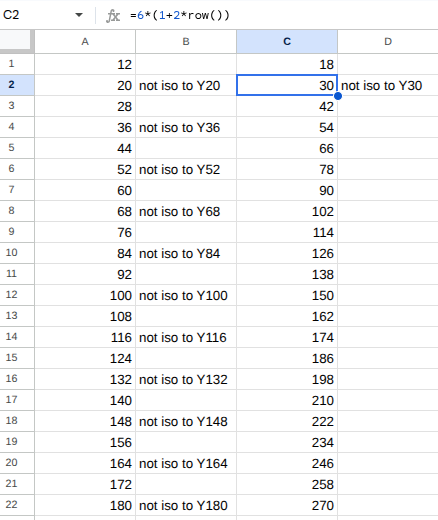
    When thinking about isomorphisms or not you may end up considering X and P and conjectures about their order with a table inspired by the following:

    In that table I say ‘not iso’ but these are open questions which I have provided no answer to.

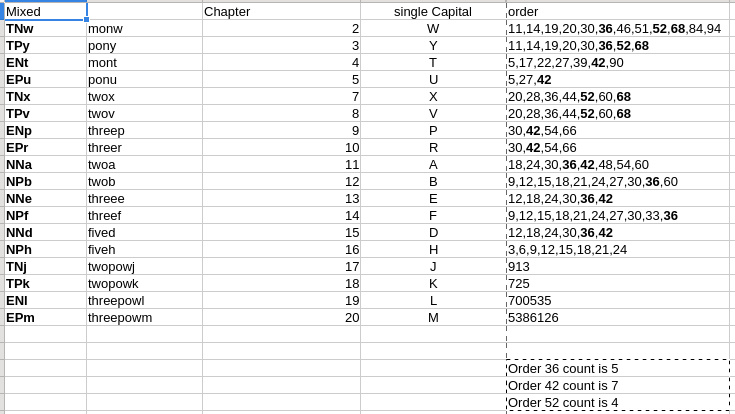
    For questions about order 36, 42, 52, 68 the following group lists may give you cyclic [abelian] group examples to use as examples when talking about where multiplicative groups having that order occur.

    Lookup table with highlighted entries for order 36,42,52,68

    If you are still short of project material, then you can always prove some conjectures