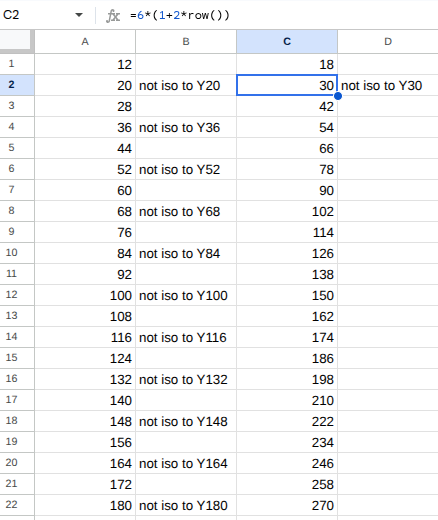
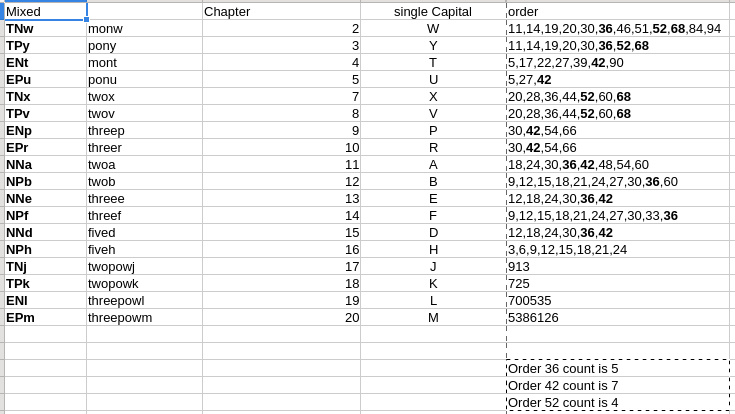
An isomorphism is said to be structure preserving
In fact relationships between elements are maintained even if the elements are renamed or reordered
But what if a finite multiplicative cyclic group has a secondary feature?
Allowing both relabelling and reordering means this secondary feature is no longer accessible or usable.
Does this prevent the mapping being structure preserving?
A truly structure preserving mapping would allow the use of the secondary feature even after reordering and relabelling.
Best illustrated with examples.
Using a generating element of 65 and working modulo 8321 we obtain the 52 element multiplicative group shown next.
{ 65,4225,32,2080,2064,1024,8313,7801,7805,8065,
2,130,129,64,4160,4128,2048,8305,7281,7289,
7809,4,260,258,128,8320,8256,4096,8289,6241,
6257,7297,8,520,516,256,8319,8191,8192,8257,
4161,4193,6273,16,1040,1032,512,8317,8061,8063,
8193,1 }
There is a secondary feature in that group that allows us to jump to a portion of our group and be at most 7 elements from the element we require.
Every eighth element after 16 from the end of the group is a power of 2.
In order we would write them as follows
Writing them longhand we might say
eight from last is 16
sixteenth from last is 2^8
twentyfourth from last is 2^12
thirtysecond from last is 2^16
fortieth from last is 2^20
fortyeighth from last is 2^24
The fourth item is in bold in the group listing above and represents 2^24 mod 8321
Using sturdy element notation we might say the group we tabulated above beginning 65 is

Current theory tells us that there exists an isomorphism between this finite abelian cyclic group and the additive group Z52.
Such an isomorphism would use both relabelling and reordering.
The problem then becomes how to access the secondary feature?
We are now [after isomorphism] the group Z52 whose elements are:
{ 1,2,3,4,5,6,7,8,9,10,11,12,13,
14,15,16,17,18,19,20,21,22,23,24,25,26,
27,28,29,30,31,32,33,34,35,36,37,38,39,
40,41,42,43,44,45,46,47,48,49,50,51,52 }
By allowing reordering without being specific about tracking each element and how it maps individually, we have no way of locating an element of the secondary feature once in Z52
This prevents us from jumping to a section of the group and navigating a maximum of seven elements from that jump destination.
That secondary feature is part of our original multiplicative cyclic group.
We are unable to use that secondary feature.
Therefore we are not truly structure preserving.
Next a further example.
Using a generating element of 257 and working modulo 131585 we obtain the 68 element multiplicative group shown next.
{ 257, 66049, 128, 32896, 32832, 16384, 131553, 123361,
123377, 127489, 8, 2056, 2052, 1024, 131583, 131071,
131072, 131329, 65793, 65921, 98817, 64, 16448, 16416,
8192, 131569, 127473, 127481, 129537, 4, 1028, 1026,
512, -1, 131328, 65536, 131457, 98689, 98753, 115201,
32, 8224, 8208, 4096, 131577, 129529, 129533, 130561,
2, 514, 513, 256, 65792, 65664, 32768, 131521,
115137, 115169, 123393, 16, 4112, 4104, 2048, 131581,
130557, 130559, 131073, 1 }
Using sturdy element notation we might say the group we tabulated above beginning 257 is

Labelling that 68 element multiplicative cyclic group as TPy68.
With a jump or secondary feature similar to our previous example
eight from last is 16
sixteenth from last is 2^8
twentyfourth from last is 2^12
thirtysecond from last is 2^16
fortieth from last is 2^20
fortyeighth from last is 2^24
fiftysixth from last is 2^28
sixtyfourth from last is 2^32
The fourth item is in bold in the group listing above and represents 2^32 mod 131585.
Current theory tells us that there exists an isomorphism between this finite abelian cyclic group and the additive group Z68.
Such an isomorphism would use both relabelling and reordering.
The problem then becomes how to access the secondary feature?
We are now [after isomorphism] the group Z68 whose elements are
{ 1,2,3,4,5,6,7,8,9,10,11,12,13,14,15,16,17,
18,19,20,21,22,23,24,25,26,27,28,29,30,31,32,33,34,
35,36,37,38,39,40,41,42,43,44,45,46,47,48,49,50,51,
52,53,54,55,56,57,58,59,60,61,62,63,64,65,66,67,68 }
By allowing reordering without being specific about tracking each element and how it maps individually, we have no way of locating an element of the secondary feature once in Z68
This prevents us from jumping to a section of the group and navigating a maximum of seven elements from that jump destination.
That secondary feature is part of our original multiplicative cyclic group TPy68.
We are unable to use that secondary feature.
Therefore we are not truly structure preserving.
If the jump feature is an essential part of the multiplication operation, then you cannot have a structure preserving map.
Do we make a special case for this type of group, or do we modify or qualify current theory?
A question that might be hard to answer is do we in fact have the jump feature in the Z group and just need to add something to the labelling to allow it to operate [again]?
Want to try and highlight in bold the elements in the Z group?
Would that be enough?