Tag: group

  • Does widening a definition weaken it?

    Why do we need another definition?

    We have the definition for generator being an element of a group.

    But a sturdy element is instead an element of a set.

    We could widen the definition for generator to be an element of a set.

    Would that create problems?

    Should we say super generator instead of sturdy element?

    But this might require or imply a generator could be an element of a set.

    There is nothing wrong with describing the results of using a sturdy element modulo enclosing set as being a cyclic group.

    However to call those results a cyclic subgroup implies a parent group and that is not always the case.

    We could widen the definition of subgroup to include a parent set also.

    Would that create problems?

    A new definition “super element” avoids having to widen existing definitions.

    Perhaps because a debate about widening generator or subgroup has not yet happened shows that these elements and their behaviour have not yet been studied more widely.

    “They are just generators”
    But they do not belong to a group [in all cases]

    “They are super generators”
    We need to be careful we do not imply group membership [in all cases] by reusing the term generator

    “They generate cyclic subgroups”
    We need to be careful we do not imply group membership [in all cases] by the current definition of a subgroup

    But wouldn’t having a sturdy element require a new notation?

    If we reuse the angle brackets that we use for generator typically then we could risk confusion.

    How about double angle brackets

    <<-1+2^t>> for the sturdy element -1+2^t

    <<1+2^t>> for the sturdy element 1+2^t

    <<-1+3^t>> for the sturdy element -1+3^t

    <<1+3^t>> for the sturdy element 1+3^t

    Each of those sturdy elements has a context set or enclosing set so should be quoted in more complete form as shown next.

  • Defining a sturdy element

    The set of elements modulo 35 is a set


    Working modulo 35 does not give you a group because we can find zero divisors and those are not invertible.

    Multiples of 5 and 7 are zero divisors because they are divisors of 35.

    There is no inverse for the elements 5, 7, 10, 14, 15, 20, 21, 25, 28,30 in that set

    Listing the elements not on that list gives us a subset consisting of 24 elements as follows
    { 1,2,3,4,6,8,9,11,12,13,16,17,18,19,22,23,24,26,27,29,31,32,33,34 }

    Does the zero divisor 5 generate a group?

    Powering of 5 just gives us a series of non-invertible results
    { 5, 25, 20, 30, 10, 15 }

    Our generated results do not include the identity element 1 or similar and as we noted there are no inverses.


    Does the element 6 generate a group?

    We obtain a cyclic group having 2 elements { 6, 1 }

    Does the zero divisor 7 generate a group?

    Successive powering of 7 just gives us a series of non-invertible results { 7, 14, 28, 21 }

    Our generated results do not include the identity element 1 or similar and as we noted there are no inverses.

    Does the element 3 generate a multiplicative group?

    We obtain a cyclic group having 12 elements
    { 3, 9, 27, 11, 33, 29, 17, 16, 13, 4, 12, 1 }

    Does the element 11 generate a multiplicative group?

    We obtain a cyclic group having 3 elements { 11, 16, 1 }

    Next we attempt to define what a super element is


    (i) A sturdy element requires context
    [ a set in which it’s properties are special ]

    (ii) A sturdy element always generates a group [or stronger] from that enclosing context.

    (iii) A sturdy element generates a multiplicative group whose order is

    <=(n−1)2<= \frac{(n−1) }{2}


    (iv a) A sturdy element shares the context set with an element that generates a maximal group (n-1) elements (depending on the value of our source variable [t])


    (iv b) A sturdy element shares the context set with an element that generates a near maximal group (n-1-zero divisors based adjustment) elements (depending on the value of our source variable [t])

    For the set

    1+(−1+2t)∗(2t+1)1+(-1+2^t)*(2^{t+1})

    the element -1 + 2^t is a sturdy element

    For the set

    1+(−1+2t)∗(2t+1)1+(-1+2^t)*(2^{t+1})

    the element 392+t is not a sturdy element

    Setting t=5 we obtain 397 for 392+t

    Working modulo 1985 we obtain the following from successive powering of 397
    { 397, 794, 1588, 1191, 397, … }

    That subset cannot be a group because it contains a zero divisor in 397

    That series of elements is not a group so our element 392+t fails property (ii) and is therefore not a sturdy element.

    For the set

    1+(1+2t)∗(2t+1)1+(1+2^t)*(2^{t+1})

    the element 1 + 2^t is a sturdy element.

    For the set

    1+(1+2t)∗(2t+1)1+(1+2^t)*(2^{t+1})

    the element 105+t is not a sturdy element.

    Setting t=4 we obtain 109 for 105+t


    Working modulo 545 we obtain the following from successive powering of 109 { 109, 436, 109 }


    That subset cannot be a group as it contains a zero divisor in 109

    That series of elements is not a group so our element 105+t fails property (ii) and is therefore not a sturdy element.

    For the set

    1+(−1+3t)∗(3t+1)1+(-1+3^t)*(3^{t+1})

    the element -1 + 3^t is a sturdy element

    For the set

    1+(−1+3t)∗(3t+1)1+(-1+3^t)*(3^{t+1})

    the element 38+t is not a sturdy element

    Setting t=5 we obtain 43 for 38+t

    Working modulo 2107 we obtain the following from successive powering of 43
    { 43, 1849, 1548, 1247, 946, 645, 344, 43, … }

    That subset cannot be a group as it contains a zero divisor in 43

    That series of elements is not a group so our element 38+t fails property (ii) and is therefore not a sturdy element.

    For the set

    1+(1+3t)∗(3t+1)1+(1+3^t)*(3^{t+1})

    the element 1 + 3^t is a sturdy element

    For the set

    1+(1+3t)∗(3t+1)1+(1+3^t)*(3^{t+1})

    the element 25406+t is not a sturdy element

    Setting t=5 we obtain 25411 for 25406+t


    Working modulo 177877 we obtain the following from successive powering of 25411 { 25411 }

    That subset cannot be a group as it contains a zero divisor in 25411

    That series of elements is not a group so our element 24506+t fails property (ii) and is therefore not a sturdy element.

    Author: Gary Wright 2026

    This post appears as the first chapter in a draft book and is available as a pdf

  • What’s in a name “The monty and pony papers”

    Finding new Mathematical structures is not just fun, that knowledge needs to be shared.

    Something that has not been straightforward is the naming of groups.

    At least two of these groups have new structures that are not isomorphic to any existing cyclic group.

    They will eventually obtain a generally agreed name, however in the meantime the question of naming needed an answer

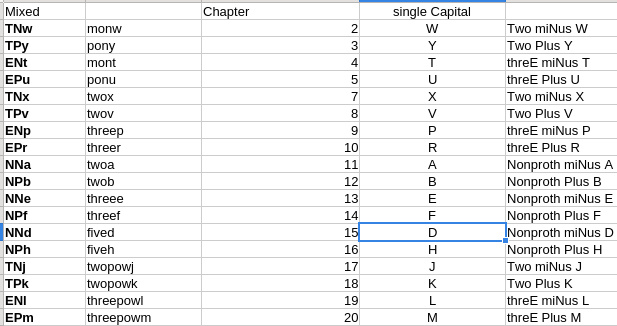
    Started out using just capital letter and then found that I had used up A, B, E, F, J, K, L, M, P, R, T, U, V, W, X, Y

    Some of those letters may already be used by convention for other things. What to do?

    First attempt at a unique naming scheme that was not single letters resulted in long names.

    Second attempt resulted in group names prefixed by 3 letters.

    In your own papers you are free to use whatever of those naming schemes are a best fit or perhaps just G and S or something in keeping with your other Abstract Algebra papers.

    In a table, those names look like the following:

    Naming by chapter

    One of the things I tried to consider is the group name as part of an individual paper, or a group name as part of a wider context.

    Both have advantages.

    “The monty and pony papers” is just a light hearted concatenation of interim names for what was T and Y

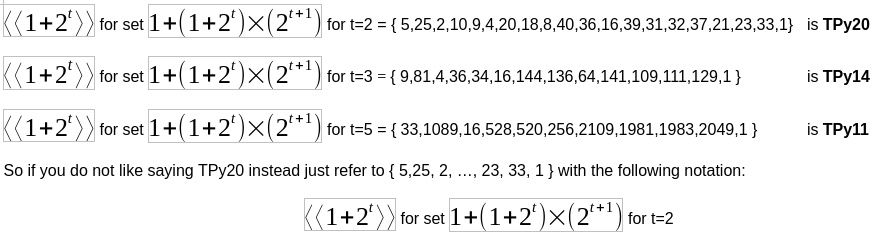
    For an alternative to using [unique] names to groups you could use sturdy element notation as the following example illustrates.

    For referencing any of the group entries in Y you simply need to add a t=number suffix to the notation below:

    Super element notation for ⟨⟨1+2^t⟩⟩ for set 1+(1+2^t)*(2^(t+1))
    Super element notation for ⟨⟨1+2^t⟩⟩